

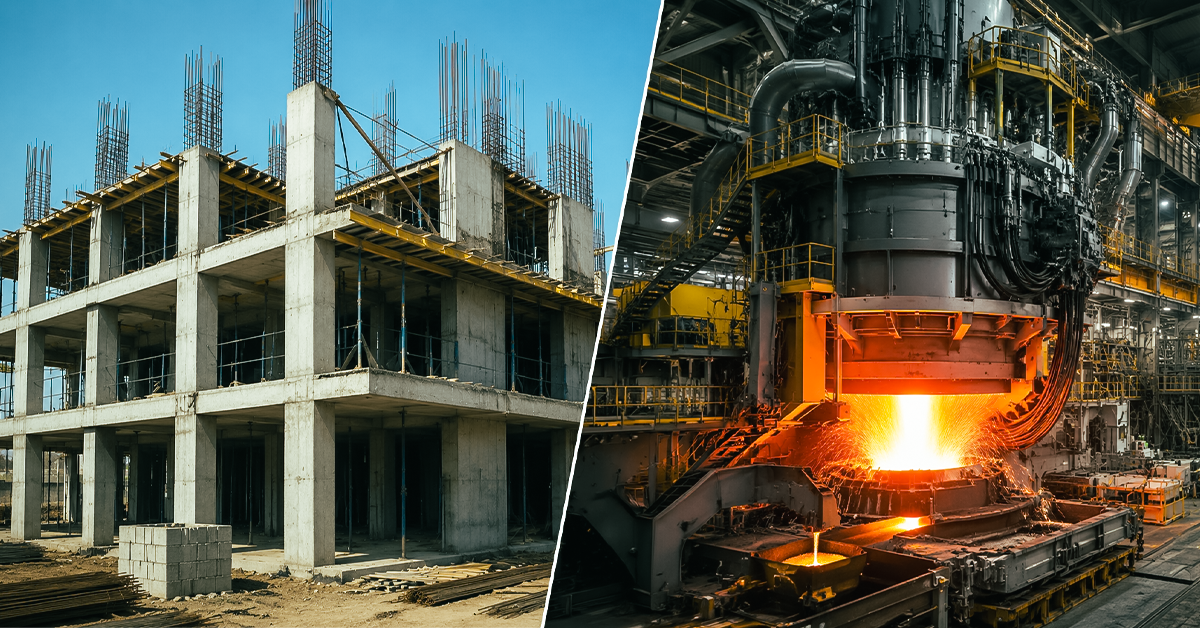
Electric Arc Furnace steel, or EAF steel, is becoming an important topic in modern construction because buyers are looking at both structural safety and responsible steelmaking. In RCC construction, steel quality matters because reinforcement bars are placed inside concrete and become part of the structure’s strength system.
However, EAF steel should not be judged only by the furnace route. Its value depends on how the steel scrap or metallic input is selected, refined, tested and converted into compliant rebars. When produced through a controlled process, EAF steel can support reliable rebar performance. When produced without proper control, it can create quality risks. This is why buyers should understand the difference between scientifically manufactured EAF steel and poorly controlled scrap-based steel.
What is Electric Arc Furnace (EAF) steel?
Electric Arc Furnace steel is steel produced by melting steel scrap or other metallic inputs using powerful electric arcs. Instead of depending mainly on iron ore and coke, the EAF route can use recycled steel scrap as a key raw material.
This makes EAF steel important from both quality and sustainability perspectives. It can support steel recycling, reduce dependence on virgin raw materials and help the construction sector move towards more resource-efficient steelmaking.
However, EAF steel is not automatically better or safer only because it is produced in an electric furnace. The final quality depends on scrap sorting, refining, chemistry control, rolling, testing and compliance with applicable primary steel standards.
Quick answer: How does EAF steel support safer RCC construction?
EAF steel can support safer RCC construction when it is produced through a scientifically controlled process. In a modern EAF plant, scrap is sorted, analysed, refined and tested before it becomes finished rebar. This helps control chemistry, reduce harmful impurities, improve consistency and produce rebars with reliable strength, ductility, bendability and corrosion behaviour.
However, EAF construction steel is not automatically safer simply because it is made in an electric furnace. Its safety value depends on process control, BIS compliance, mechanical properties, chemical consistency, concrete quality and site workmanship.
Why does steel quality matter in RCC construction?
Steel quality matters because rebars hold the RCC structure together. They help foundations, beams, columns, slabs, staircases and walls resist load, movement, shrinkage, cracking and stress.
A rebar should not only be strong. It should also be ductile, bendable, consistent, corrosion-resistant and capable of bonding properly with concrete. If the steel has inconsistent chemistry or poor ductility, it may behave unpredictably under stress, especially during earthquakes, heavy loading or long-term exposure to moisture.
In RCC construction, safety is not decided by one factor. It depends on the combined quality of steel, concrete, curing, structural design and site execution.
Why is strength alone not enough for RCC safety?
Strength alone is not enough because a rebar must do more than carry load. A very strong bar may still be unsuitable if it does not deform properly under stress or if it fails in a brittle manner.
Safer RCC construction depends on a balance of:
- Yield strength
- Ultimate tensile strength
- UTS/YS ratio
- Elongation
- Bend and rebend performance
- Bond with concrete
- Fatigue behaviour
- Chemical composition
- Batch-to-batch consistency
During earthquakes, vibration or dynamic loading, reinforcement steel should absorb energy and allow controlled deformation. This is why ductility and elongation are important along with strength.
How does EAF steel improve rebar performance in RCC?
EAF steel can improve rebar performance when the production process is controlled at every stage. In a modern EAF route, the manufacturer can monitor scrap quality, molten steel chemistry, refining, casting, rolling and testing. This helps reduce unwanted variation and supports predictable rebar properties.
Good process control helps manage:
- Carbon content
- Sulphur content
- Phosphorus content
- Copper and tin contamination
- Yield strength
- Tensile strength
- Elongation
- Bend and rebend performance
- Weldability
- Dimensional consistency
For use in RCC,EAF-based rebars must comply with IS 1786:2008 and its latest amendments. This standard defines the required mechanical and chemical properties for high-strength deformed steel bars and wires used in concrete reinforcement. Buyers should therefore look at the final rebar quality, not just the steelmaking route.
Is scrap-based EAF steel safe for RCC buildings?
Yes, scrap-based EAF steel can be safe for RCC buildings when the scrap is properly segregated, refined and tested. The use of scrap itself does not make steel inferior. What matters is whether the manufacturer has strong process control and quality assurance.
Modern EAF plants use controlled scrap sourcing, ladle refining, chemistry monitoring, temperature control, continuous casting and laboratory testing. These systems help produce rebars with consistent mechanical properties and controlled chemical composition.
The concern arises when mixed scrap is melted in poorly controlled units without proper refining or testing. In such cases, impurities may remain uncontrolled and the rebar may show variation in ductility, weldability, corrosion behaviour and long-term performance.
How does EAF steel support earthquake-resistant construction?
EAF steel can support earthquake-resistant construction when it is manufactured into ductile rebars that meet the required standards and structural design needs. During an earthquake, RCC members may face repeated stress reversals and deformation.
Ductile rebars help the structure absorb seismic energy. They allow controlled deformation before failure, which is safer than sudden brittle failure.
For earthquake-resistant RCC construction, engineers usually look for:
- Higher ductility
- Reliable elongation
- Proper UTS/YS ratio
- Bendability
- Consistent rib pattern
- Strong bond with concrete
- Correct detailing as per structural drawings
- Proper placement and cover
EAF steel can contribute to this safety when the steelmaker controls chemistry, refining, rolling and testing properly.
Does EAF steel affect corrosion resistance in RCC?
EAF steel can support better corrosion performance when the steel has controlled chemistry and low variation in residual elements. Corrosion in RCC occurs when moisture, oxygen, carbon dioxide or chlorides reach the embedded steel through porous or cracked concrete.
Steel with inconsistent chemistry may show unpredictable corrosion behaviour. Modern EAF processing can reduce this risk by improving metallurgical consistency, provided the scrap is properly refined and the final steel is tested.
However, steel quality alone cannot prevent corrosion. RCC durability also depends on:
- Concrete mix design
- Water-cement ratio
- Proper compaction
- Adequate cover
- Good curing
- Use of suitable cement
- Exposure conditions
- Site workmanship
Even high-quality steel can corrode if the concrete is porous, badly cured or cracked.
Why does concrete quality matter along with steel?
Concrete quality matters because concrete protects the steel from the external environment. Even the best rebar can suffer corrosion if concrete is porous, poorly cured or badly compacted.
Good RCC construction needs both good steel and good concrete. The steel provides tensile strength and ductility. The concrete provides compression strength and protection against moisture and chemicals.
For long-term performance, site teams should ensure:
- Proper concrete grade
- Correct mix design
- Good compaction
- Adequate curing
- Correct cover blocks
- Low permeability
- Proper placement of reinforcement
- Engineer-approved detailing
EAF steel can support RCC safety, but it cannot compensate for poor concrete practice.
What role does BIS compliance play in EAF rebar safety?
BIS compliance plays an important role because rebars in India are governed by standards that define mechanical and chemical requirements. These include yield strength, tensile strength, elongation, bend performance, chemical composition and dimensional tolerances.
For EAF-based rebars, buyers should check compliance with IS 1786:2008 and its latest amendments. However, safety-conscious buyers should also understand that minimum compliance is not the same as superior consistency.
Reputed manufacturers often maintain tighter internal controls than the minimum required values. This can improve batch-to-batch reliability and long-term confidence in RCC performance.
EAF vs BF-BOF steel: Which is better for RCC construction?
Both EAF steel and BF-BOF steel can be suitable for RCC construction when produced under strong quality control. BF-BOF steelmaking starts with iron ore and has traditionally been associated with strong chemistry control in integrated steel plants. Modern EAF steelmaking uses scrap but can also achieve strong quality control through sorting, refining and testing.
| Safety factor | BF-BOF route | Modern EAF route |
| Raw material | Iron ore, coke and limestone | Scrap and metallic inputs |
| Quality potential | High when produced in integrated plants | High when scrap is controlled and refined |
| Sustainability | Higher carbon footprint | Lower-carbon potential |
| Chemistry control | Strong in organised plants | Strong in modern controlled plants |
| RCC suitability | Good when standards are met | Good when standards are met |
| Buyer focus | Grade, certification, consistency | Grade, certification, process control |
The right question is not “Which route is always better?” The better question is “Was the steel scientifically manufactured, tested and certified for the structure?”
What should buyers check before using EAF steel?
Before using EAF steel in RCC construction, buyers should ask:
- Is the rebar BIS-certified?
- Is the steel produced by an organised manufacturer?
- What quality control systems are followed?
- Is the steel suitable for the structural design?
- Are test certificates available?
- Is the dealer authorised?
- What are the yield strength and tensile strength values?
- What is the elongation value?
- Is the rebar suitable for seismic conditions?
- Is the steel being stored and handled properly at site?
- Is the final price based on weight, piece or bundle?
These questions help buyers understand whether the steel supports both safety and value.
What mistakes should buyers avoid?
Buyers should avoid assuming that all EAF steel is the same. They should also avoid assuming that all scrap-based steel is poor. Both assumptions are wrong.
Common mistakes include:
- Judging steel only by price
- Ignoring BIS certification
- Not checking the grade
- Not asking about dealer authenticity
- Assuming scrap-based steel is inferior
- Assuming EAF steel is automatically superior
- Ignoring concrete quality
- Ignoring curing and site workmanship
- Not checking storage and handling conditions
- Using steel without structural engineer approval
A safe RCC structure depends on the full chain of quality, from steelmaking to site execution.
Expert insight: What is the real safety value of EAF steel?
The real safety value of EAF steel lies in controlled steelmaking. Scrap can be transformed into reliable construction-grade steel when it is properly sorted, refined, tested and rolled under strict quality systems. In such cases, EAF steel can offer both performance and sustainability benefits.
However, safety does not come from the furnace route alone. It comes from consistency, ductility, chemical control, BIS compliance, concrete quality, correct detailing and disciplined site supervision. For RCC construction, the safest approach is to choose certified rebars from reputed manufacturers and ensure that they are used with good concrete and proper construction practices.
For buyers evaluating Tata Tiscon EAF steel, the focus should remain on the final rebar being used: its grade, compliance, product details, dealer authenticity, structural suitability and approval by the engineer. This helps buyers look beyond the steelmaking route and make a decision based on safety, quality and long-term construction value.
