

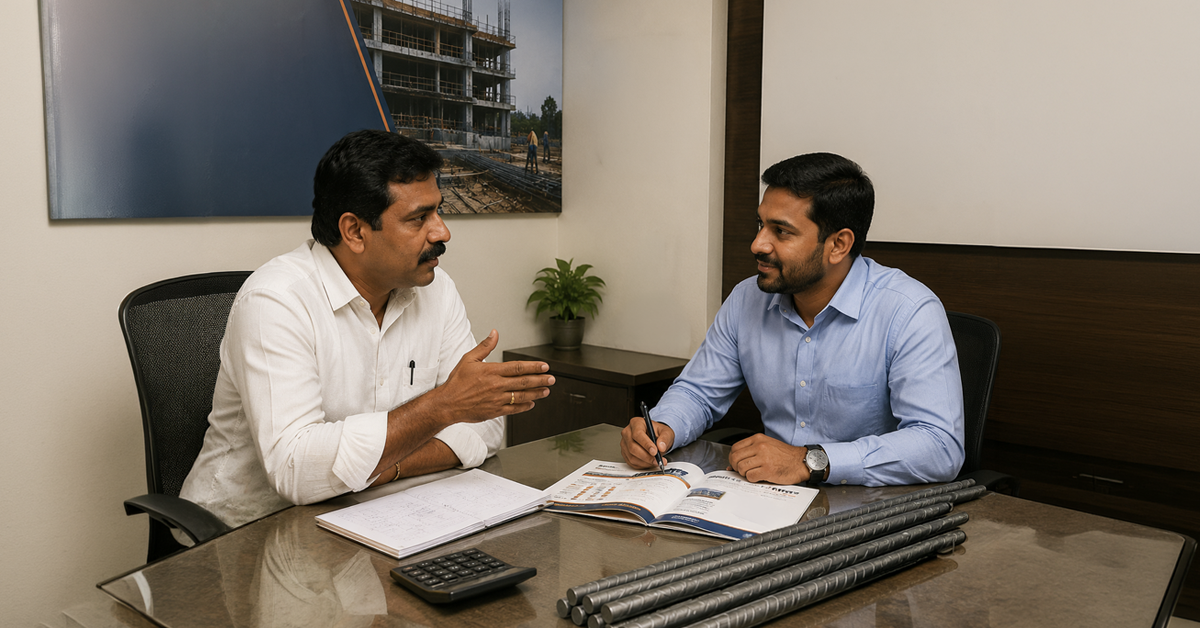
Buying TMT bars is not only about asking for the latest sariya rate. The right questions can help buyers check product quality, authenticity, cost clarity and suitability before the steel reaches the construction site.
TMT bars form the reinforcement inside concrete, which means they directly support foundations, columns, beams, slabs and other load-bearing elements. Once the concrete is cast, it becomes difficult and expensive to correct steel-related mistakes. This is why buyers should speak to the TMT bars manufacturer or authorised TMT bars dealers with a clear checklist.
Why asking the right questions matters
The right questions help buyers understand:
- Whether the TMT bar suits the structural design
- Whether the product meets Indian quality standards
- Whether the manufacturer has reliable process control
- Whether the steel is suitable for local weather and site conditions
- Whether the dealer or supplier is genuine
- Whether the final cost includes delivery, taxes and handling
- Whether technical support is available if needed
A serious manufacturer will not only sell steel but also help the buyer understand product suitability.
Key questions every buyer should ask
Before selecting TMT bars, buyers should ask a few basic questions. These questions help compare products more clearly and reduce the risk of choosing steel only by price.
| Question | Why it matters |
| Which grade of TMT bar do you offer? | Helps match the steel with the structural requirement. |
| Does the TMT bar conform to BIS standards such as IS 1786 and carry ISI marking where applicable? | Helps buyers check whether the product follows recognised Indian quality requirements for reinforcement steel. |
| What diameters are available? | Different structural members need different bar sizes. |
| What tests are performed on the bars? | Helps confirm strength, ductility, elongation and bendability. |
| Is a test certificate available? | Useful for every residential project because it helps buyers verify product quality, batch details and compliance before the steel is used. |
| What is the final landed cost? | Helps compare price with tax, delivery and unloading included. |
| Is the dealer authorised? | Reduces the risk of duplicate or substandard material. |
| What support is available after purchase? | Useful for estimation, usage queries, storage guidance and site support. |
What should buyers ask TMT bar dealers before placing an order?
Buyers should ask TMT bar dealers about authenticity, price transparency, stock availability, delivery support and documentation before placing an order. Even if the manufacturer is reliable, the dealer plays an important role in ensuring that the right grade, size and quantity reach the construction site on time.
Important questions include:
- Are you an authorised dealer for this TMT bar brand?
- Can you provide a proper GST invoice?
- Is the quoted rate based on weight, piece, bundle or tonne?
- Does the price include GST, delivery and unloading?
- Are the required diameters available in stock?
- Can you supply the full quantity as per the engineer’s requirement?
- Is the material coming with product markings, tags or authenticity checks?
- What is the delivery timeline?
- Is there support if the wrong size or damaged material is delivered?
- Can you provide test certificates or batch details ?
A good dealer should not only offer a competitive rate but also provide clarity, genuine material, correct billing and dependable delivery. For first-time home builders, choosing the right TMT bar dealer is as important as choosing the right TMT bar manufacturer.
Questions first-time home builders should ask
First-time home builders usually focus on price because they are trying to manage the construction budget. However, they should begin with the structural engineer’s recommendation.
Important questions include:
- What grade has my engineer recommended?
- Which diameters are needed for foundations, columns, beams and slabs?
- Is the product suitable for my local climate?
- Is my site in a high-rainfall, coastal, humid or earthquake-prone region?
- Will the manufacturer or dealer provide a proper invoice?
- Is the steel sold by weight, piece or bundle?
- How should the bars be stored at the site?
For a homeowner, the goal is not to buy the cheapest TMT bar. The goal is to buy the right steel for the right part of the house.
Questions contractors should ask
Contractors need to think about both quality and site execution. They handle cutting, bending, fixing, storage and sequencing. Therefore, their questions should focus on consistency and workability.
| Contractor question | Reason |
| Are the bars consistent in length and diameter? | Helps reduce site confusion and wastage. |
| Do the bars bend properly without cracking? | Important for bar bending and reinforcement detailing. |
| Is supply available in multiple diameters? | Helps manage foundation, column, beam and slab work. |
| Can delivery be scheduled as per site progress? | Prevents overstocking and delays. |
| Are ready-made stirrups or links available? | Can save labour time and improve accuracy. |
| What is the replacement process for damaged or wrong material? | Helps avoid project delays. |
Contractors should also ask about storage guidance, especially during monsoon or on sites where steel may remain unused for several days.
Questions architects and structural engineers should ask
Architects and structural engineers are more concerned with performance and design suitability. They should ask detailed technical questions before recommending a TMT bar manufacturer.
| Technical question | Why it matters |
| What are the yield strength and tensile strength values? | Helps evaluate load-carrying performance. |
| What is the elongation value? | Indicates ductility and deformation capacity. |
| What is the UTS/YS ratio? | Important for ductile and seismic performance. |
| What is the chemical composition? | Affects weldability, ductility and corrosion behaviour. |
| Does the bar conform to relevant Indian Standards? | Supports design and compliance confidence. |
| How is quality controlled during manufacturing? | Indicates process reliability. |
In earthquake-prone zones, engineers may pay special attention to ductility, elongation, bendability and consistency across batches.
Questions about local climate and site conditions
India has varied construction conditions. A TMT bar suitable for one region may need different storage or corrosion protection practices in another.
| Site condition | What to ask the manufacturer |
| Coastal or humid areas | Is the bar suitable for humid or coastal conditions, and what concrete cover and storage practices are recommended? |
| High-rainfall regions | How should bars be stored before use? |
| Earthquake-prone zones | Is a grade with higher ductility and elongation suitable as per the engineer’s recommendation? |
| Industrial areas | Is the steel suitable for aggressive exposure conditions? |
| Waterlogged plots | What protection is needed against corrosion risk? |
| Hot and dry regions | What curing and bonding practices should be followed? |
These questions help buyers match steel selection with real site conditions, not just general specifications.
Questions about price and delivery
Price should be checked carefully, but it should not be checked in isolation. Buyers should ask for the final cost at site.
Price-related checklist:
- What is the rate per kg, tonne, piece or bundle?
- Does the rate include GST?
- Is delivery included?
- Is unloading included?
- Are there minimum order requirements?
- Is the price valid for a fixed period?
- Is there a written quotation?
A transparent manufacturer or authorised dealer should clearly explain the pricing basis.
Questions about authenticity and support
In India, duplicate or poor-quality steel can be a concern. Buyers should therefore ask how to verify authenticity.
Ask:
- How can I identify genuine material?
- Are there product markings or tags?
- Is the dealer authorised?
- Will I receive a proper invoice?
- Is customer support available?
- Can someone help with material estimation?
These questions are especially important for first-time home builders who may not know how to distinguish genuine steel from poor-quality alternatives.
For buyers considering Tata Tiscon, the dealer locator can help them find authorised TMT rebar and Superlinks dealers near their location. Instead of depending only on local recommendations or the lowest quotation, buyers can use it to verify availability, compare product details and connect with trusted supply points. In construction, better questions lead to better decisions. When buyers check both the manufacturer’s quality and the dealer’s authenticity, they are more likely to receive genuine material, transparent pricing and dependable support for their project.
