

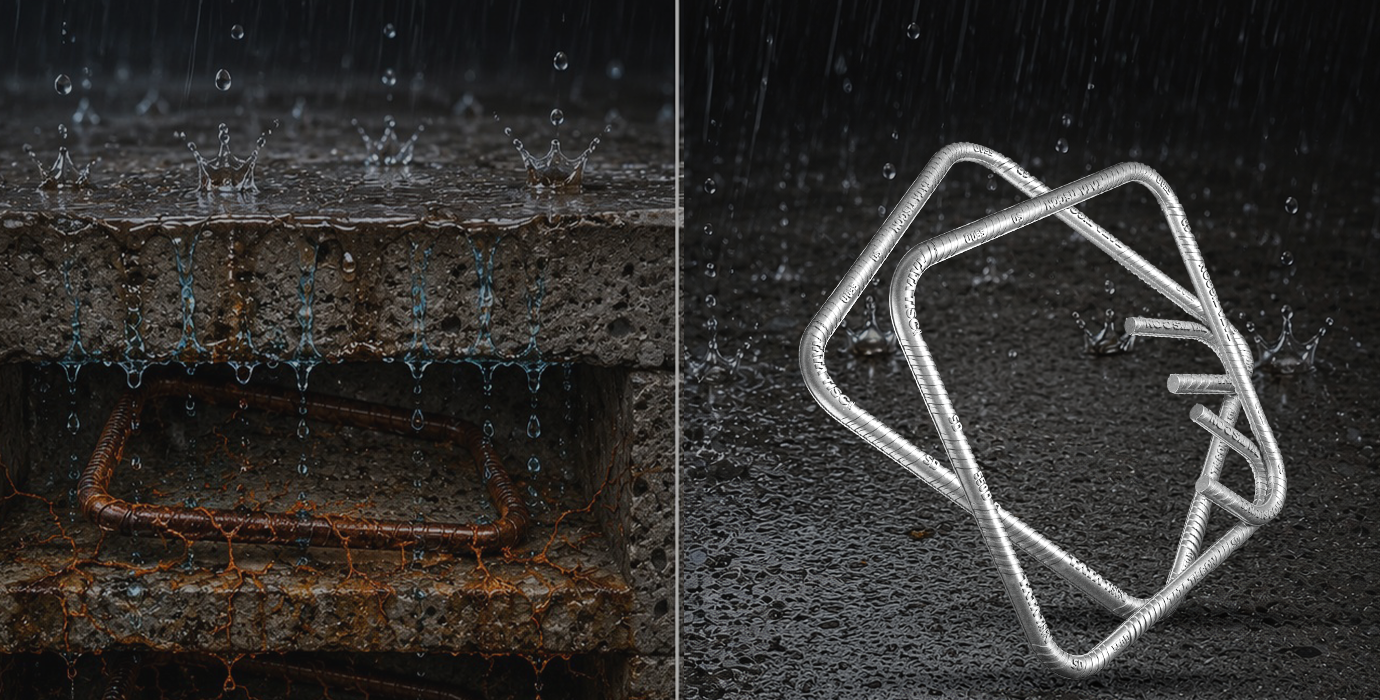
When home builders plan structural procurement, most attention goes toward primary TMT rebars – grades, diameters, and total quantities. The steel loops that hold those bars together, known as construction stirrups, rarely receive the same scrutiny. Yet stirrups directly determine whether a column holds its geometry under axial load, whether a beam resists shear forces from floor weight and seismic activity, and whether reinforcement remains protected from moisture ingress across the life of the structure.
This construction stirrups buying guide for home builders covers the structural role of stirrups, how wet weather affects reinforcement on site, what to evaluate during procurement, and how to store material correctly during monsoon construction.
Why Stirrups Matter in Home Construction
Columns and beams in reinforced concrete structures use composite systems, with concrete handling compressive forces and steel managing tension and shear. Primary vertical rebars carry the main load but require lateral confinement from stirrups to function reliably. Without properly spaced and formed stirrups, vertical bars can buckle, leading to structural unreliability. The selection and installation of stirrups therefore carry the same structural significance as the primary rebars they confine.
The Role of Stirrups in Structural Strength
Primary vertical rebars carry compression, but they tend to buckle outward under load without lateral support. Stirrups for home construction hold vertical rebars parallel, prevent buckling, and absorb shear stresses caused by floor weight and seismic forces. Correctly placed stirrups maintain the position of the rebar cage, which in turn preserves the required concrete cover thickness. Using high strength construction stirrups preserves mandatory concrete cover, shielding inner steel from moisture exposure.
Why Quality Becomes Even More Important During the Monsoon
Monsoon conditions, characterised by high humidity and prolonged rainfall, lead to the deterioration of poorly manufactured steel before it is encased in concrete. Stirrups manufactured without consistent quality control or proper certification may be more vulnerable to corrosion-related issues when exposed to prolonged moisture before concrete placement. During wet construction, selecting corrosion resistant construction stirrups along with proper storage and handling practices helps protect reinforcement from prolonged moisture exposure before concrete placement.
How Rain Can Affect Reinforcement
Wet weather poses two main risks to site reinforcement: surface oxidation due to rainfall and humidity, and internal structural damage from unmanaged corrosion in concrete. Recognising the difference prevents unnecessary rejection of acceptable material and ensures that genuinely damaging corrosion is not underestimated. Effective risk management entails selecting appropriate materials, ensuring proper site storage, and maintaining handling discipline during the monsoon construction period.
Moisture, Rust and Long-Term Durability
Light surface rust from brief ambient exposure is normal oxidation and is generally acceptable after visual inspection, provided bar diameter and rib patterns remain intact. However, prolonged unprotected exposure in wet conditions can lead to heavy scaling, deep pitting, and structural risks. This occurs as iron reacts with water and oxygen, causing rust to expand and exert internal tensile pressure that hardened concrete cannot resist.
The resulting sequence is:
- Hairline cracks develop along column and beam surfaces
- Moisture penetrates through these cracks, accelerating deeper corrosion
- Concrete cover spalls, directly exposing the rebar cage to the environment
- Structural section loss begins, progressively reducing load-carrying capacity
Using certified rust resistant construction stirrups, together with proper storage and construction practices, helps reduce the likelihood of this progression over the life of the structure.
Common Storage and Handling Mistakes
Errors in site handling during the monsoon can severely compromise properly manufactured and delivered steel. Storing bundles on wet soil leads to pitting corrosion from pooled groundwater, while covering wet steel with airtight tarps traps moisture, accelerating oxidation. Excessive manual re-bending may damage the steel surface or alter its intended geometry, making proper handling important during construction. These issues can be prevented through effective site management practices.
What to Look for When Buying Stirrups
Evaluating construction stirrups for residential use requires assessing both manufacturing quality and dimensional consistency. The manufacturing method affects geometric precision and steel integrity, while material grade influences mechanical performance and durability. A stirrup must meet specifications in both areas to be deemed acceptable, as deficiencies in either can pose risks.
Factory-Made vs Manually Bent Stirrups
Tata Tiscon Superlinks are factory-made stirrups manufactured using automated production processes to achieve consistent dimensions, accurate bends, and uniform quality. Tata Tiscon Ultima GFX Coated Superlinks build on these advantages with a specialised corrosion-resistant coating for applications where additional protection against moisture exposure is beneficial. Compared with manually bent stirrups, factory-made Superlinks provide greater dimensional consistency, minimise bending variations, and help maintain reinforcement geometry during construction.
Quality, Precision and Material Considerations
Choosing the best construction stirrups in India involves confirming that they comply with applicable BIS requirements, are manufactured under controlled quality processes, and provide consistent dimensions for reliable reinforcement placement. Uniform rib geometry supports effective bonding with concrete, while production documentation such as the Mill Test Certificate helps verify material quality and manufacturing consistency.
Tips for Buying Superlinks During the Rainy Season
Monsoon procurement poses unique risks, including supply disruption and pressure to compromise on stock certification. A structured sourcing and storage approach during the wet season is essential to safeguard material quality and budget. Key quality controls include verifying supplier authorisation, confirming BIS certification, and enforcing storage standards on material delivery, which are critical to avoiding material risks in permanent structures.
Choosing a Reliable Supplier
Buy genuine stirrups online through the manufacturer’s official website or authorised dealers to ensure access to product documentation, applicable certifications, and verified supply channels. Consider the complete delivered value, including quality assurance, consistency, and traceability, instead of comparing only the lowest purchase price.
Ensuring Proper Storage Before Use
Once steel arrives on site, enforce the following storage mandates:
- Elevate bundles on timber sleepers or concrete blocks at least 150mm above ground level.
- Store materials in a covered, ventilated shed if space allows.
- If outdoor storage is necessary, use a tarpaulin on a sloped frame for air circulation and rain protection.
- Inspect stored stirrups before installation; light surface rust is acceptable, but heavy scaling, flaking, or pitting needs technical evaluation before use.
Securing Your Home’s Structural Future
The best construction stirrups in India combine factory-controlled manufacturing, dimensional accuracy, applicable BIS compliance, production documentation, and consistent quality. Tata Tiscon stirrups are designed to deliver these essential qualities, providing dependable structural reinforcement for residential construction.
However, when construction involves prolonged exposure to rain, high humidity, or coastal conditions, Tata Tiscon Ultima GFX Coated Superlinks offer an additional advantage through their specialised corrosion-resistant coating that provides additional protection against moisture exposure. Along with precision manufacturing and consistent quality, this added protection against moisture helps safeguard reinforcement during construction and supports long-term structural durability in moisture-prone environments.
Purchasing through authorised channels, along with proper storage and handling during the monsoon, helps home builders maximise the long-term performance and corrosion protection offered by Tata Tiscon’s GFX Coated Superlinks.
Frequently Asked Questions (FAQs)
What is the mandatory hook angle for stirrups according to Indian standard building codes (IS 456)?
Indian Standard IS 456 specifies a 135° hook with the required extension length. Precision-manufactured stirrups are produced with this geometry consistently, helping maintain consistent reinforcement geometry and reducing variations that can occur with manual bending.
How do I calculate the total weight and quantity of stirrups required for my home construction?
The required quantity depends on the structural drawings, stirrup spacing, member dimensions, and reinforcement detailing specified by the structural engineer. A Bar Bending Schedule provides the most accurate quantity.
Does light reddish surface rust on newly delivered stirrups mean they are defective?
No. Light surface patina is normal oxidation that does not weaken steel or reduce bar diameter. However, heavy scaling, flaking, or deep pitting should be technically evaluated before the material is used in construction.