

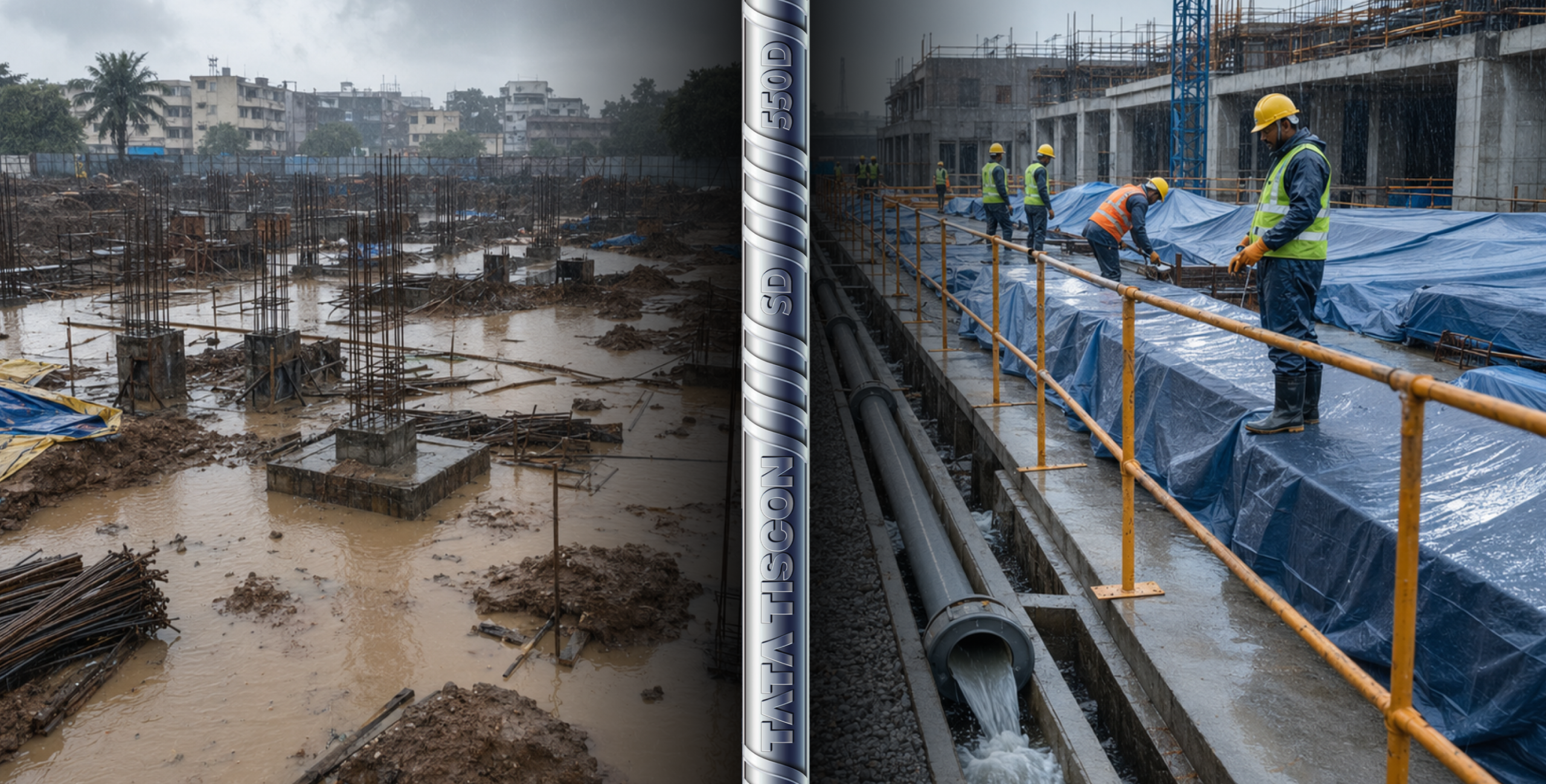
The monsoon season in India, especially in areas like Bihar, disrupts construction schedules, prompting builders to reassess the feasibility of foundation work. The decision to proceed relies more on site’s conditions, engineering readiness, and material quality than the season itself. This foundation construction guide addresses the conditions, challenges, precautions, and material considerations for building foundations in wet weather.
Can Foundation Work Be Done During the Monsoon?
Foundation construction in the rainy season is viable but necessitates a detailed site assessment before excavation. In regions with soft clay or high-water tables, like North and South Bihar, construction is affected by ground conditions, concrete placement, and water infiltration. Structural problems may appear after occupation rather than during construction, making site-specific risk assessment essential before proceeding with foundation work during rainy season conditions.
When It’s Possible and When It Isn’t
Foundation work can proceed during monsoon when:
- The site has adequate natural drainage or installed dewatering systems
- Soil type remains stable under wet conditions – firm clay, laterite, or rocky ground
- Excavations can be protected from water accumulation during concrete pours
- Material storage and site logistics can be maintained without quality compromise
It is not advisable when:
- The site is prone to flooding or sits in a low-lying area near local river basins
- Soil is loose, expansive, or shows significant bearing capacity reduction when wet
- Continuous heavy rainfall is forecast during the planned construction window
Factors That Influence the Decision
Several site-specific variables determine whether monsoon foundation work is practically achievable:
- Soil type affects bearing capacity; fine Gangetic silt and sandy soils lose capacity when saturated, while laterite and hard murram are more reliable in wet conditions.
- A high-water table complicates dewatering and increases costs.
- Low-lying plots are at a higher risk of waterlogging and surface runoff.
- The presence of functional drainage infrastructure significantly alters the risk profile of a site.
- Depending on soil investigation and structural design, raft foundations may be more effective than isolated footings in waterlogged conditions.
Challenges of Building Foundations in Rainy Weather
Foundation work for home construction during monsoon presents unique engineering and logistical challenges, such as concrete quality, soil stability, and construction sequencing. Effective mitigation strategies must be coordinated rather than addressed individually to avoid quality failures and structural issues.
Waterlogging and Soil Conditions
Rainwater in open excavations poses a significant challenge, as concrete may dilute and lose design strength if not placed properly in the presence of standing water. Beyond dewatering, saturated ground conditions further affect:
- Wet soil has a lower load-bearing capacity compared to dry soil.
- Saturated soil cannot achieve the necessary compaction density.
- Trench walls are prone to collapse in loose, water-saturated conditions.
- Moisture beneath the Plain Cement Concrete (PCC) layer undermines the integrity of the working surface for future operations.
Concrete Curing and Construction Delays
Rainfall immediately after placement can damage fresh concrete by washing cement paste from the surface, disturbing the water-cement ratio, and causing scaling or surface defects before proper curing begins. Additional challenges include:
- Extended setting times in low-temperature, high-humidity conditions.
- Risk of segregation if concrete is poured through standing water.
- Altered mix proportions if rainwater enters batching or mixing equipment.
- Unpredictable work stoppages that affect formwork removal and construction sequencing.
Precautions to Take During Monsoon Construction
Understanding how to build a strong foundation during monsoon begins with a coordinated approach involving site drainage, excavation protection, concrete management, and material storage. The goal is to shield essential construction activities from weather exposure while ensuring consistent quality control throughout the construction process.
Site Preparation and Drainage
Before excavation begins:
- Install temporary perimeter drains to divert surface runoff away from the plot boundary
- Set up submersible pumps for active dewatering of excavation pits
- Grade the surrounding site to channel water away from open trenches
- Cover open excavations with tarpaulin or sheeting during heavy or continuous rainfall
- Compact and level the excavation base only after confirmed, complete dewatering
Material Protection and Quality Control
Selecting TMT rebars for foundation construction necessitates proper storage and handling, particularly during the monsoon. Even corrosion resistant TMT rebar requires proper site storage. While light surface rust is typically acceptable upon inspection, severe corrosion requires assessment before use. Local dealers may offer non-certified alternatives for lower prices, but these risks using materials with unverified properties that compromise structural integrity in high-moisture environments. Standard material controls during monsoon construction include:
- Store high-strength TMT Rebar bundles on elevated platforms, avoiding direct contact with wet or damp ground.
- Cover rebar stacks with tarpaulin while allowing ventilation to prevent moisture accumulation.
- Use ISI-Certified TMT Rebar and check Mill Test Certificates upon delivery acceptance.
- Obtain genuine TMT Rebar only from authorized dealers to avoid unverified channels during monsoon supply disruptions.
- Confirm TMT Rebar prices directly with authorized dealers, as monsoon logistics can impact costs and delivery.
- Reject cement bags that show visible moisture damage or signs of partial hardening.
If physical dealer access is disrupted by severe weather or local flooding, home builders can buy TMT rebar online through the manufacturer’s official authorised portal to ensure full product traceability and guaranteed quality.
Is the Monsoon the Right Time to Build?
Most individual home builders prefer to avoid starting home foundation construction during the monsoon. However, budget cycles, land possession timelines, and contractor schedules do not always allow that choice, making this a practical engineering question rather than a theoretical one.
Pros and Cons for Home Builders
| Factor | Monsoon Construction | Dry Season Construction |
| Labour availability | Generally higher; less peak-season competition | Lower; high construction demand period |
| Material pricing | May vary depending on regional demand and supply conditions. | Higher demand can push prices upward |
| Concrete curing risk | High, requires active weather protection measures | Lower, natural conditions more stable |
| Soil workability | Site-dependent; unreliable under heavy rainfall | Stable and predictable |
| Waterlogging risk | Present, requires continuous active dewatering | Minimal under normal conditions |
| Construction pace | Slower; weather stoppages cause schedule delays | Faster and more consistent |
| Quality control requirement | Intensive site supervision required throughout | Standard supervision adequate |
For home builders who cannot delay, the decision ultimately comes down to how effectively the site can be engineered to manage water – not what the calendar shows.
Making Informed Foundation Decisions
Foundation work during the rainy season can proceed successfully through adequate site preparation, experienced oversight, careful material selection, and ongoing quality control. Monsoon conditions heighten site management needs but do not hinder construction. Choosing the best TMT rebars in India, like Tata Tiscon 550SD TMT Rebar, is essential for structural integrity and seismic resistance in Bihar. Site and soil assessments should dictate construction decisions, and verified documented options are available for Tata Tiscon products through authorized dealers.
Common Questions Asked about Construction in Monsoon
Which season is best for construction?
Post-monsoon to winter (October to February) is the ideal period in most Indian regions due to stable soil, moderate temperatures, and reliable dry weather, facilitating effective concrete curing and uninterrupted construction activities.
How can construction be safe during the rainy season?
Temporary electrical installations should be weatherproofed; scaffolding stability must be verified post-heavy rain, and walkways should remain free of mud. Structural work is prohibited during active lightning or severe wind, irrespective of scheduling pressures.
How to do construction in rainy season?
Prioritise sheltered activities during active rainfall and schedule concrete pours and excavation only during confirmed dry windows. Monitoring weather and flexible scheduling are essential to maintain quality on site.